
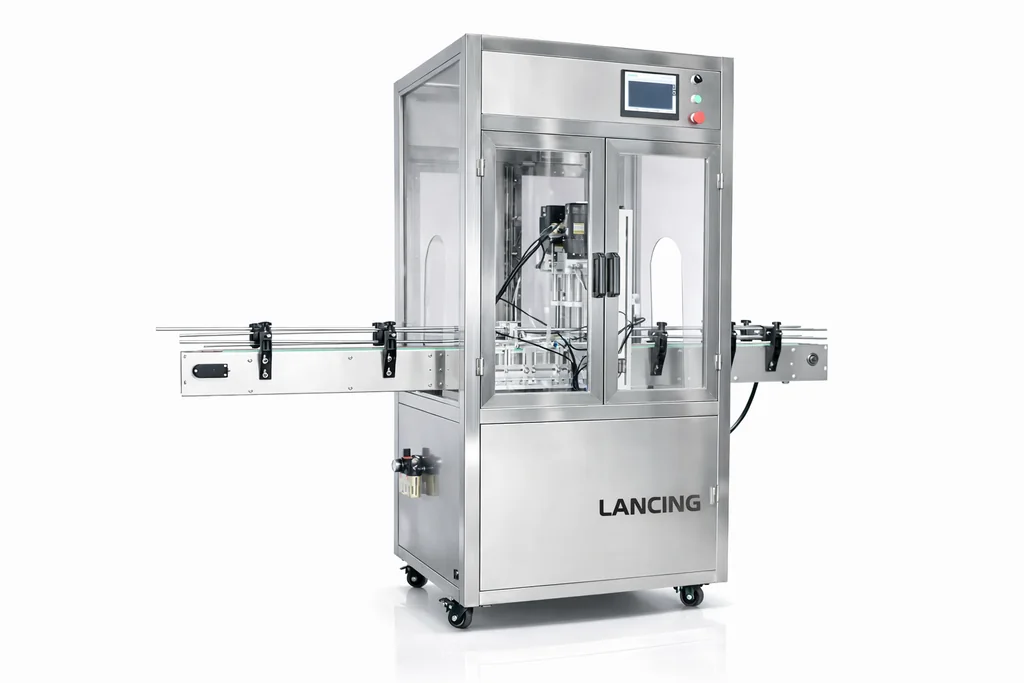
Output planning
Capping machine output: how many bottles per minute is realistic?
Guide to capping machine output, bottles per minute, cap feeding rate, operator placement, conveyor control and realistic speed planning.
Discuss this requirement →Capping machine output is not just the speed of the head. Bottle spacing, cap feeding, cap placement, conveyor control, product handling and operator tasks all affect the real bottles-per-minute figure.
Capping machine output is not just the speed of the head. Bottle spacing, cap feeding, cap placement, conveyor control, product handling and operator tasks all affect the real bottles-per-minute figure.
Guide to capping machine output, bottles per minute, cap feeding rate, operator placement, conveyor control and realistic speed planning.
Discuss this requirement →If the filler, cap feeder or labeller is slower than the capper, the capper will not achieve its theoretical maximum.
When operators place caps manually, fatigue and attention can limit sustained output.
Unstable bottles, awkward closures and frequent changeovers reduce practical output compared with simple round bottles and flat caps.
Photos and dimensions can start the discussion. Physical bottle and cap samples are normally the best way to confirm tooling, cap feeding, bottle support and realistic output.
Quoted output often assumes favourable bottle and cap conditions. Real output depends on the complete line and product format.
Sometimes. Better cap feeding, bottle spacing, guides or operator layout can improve throughput.
Provide current output, target output and whether the figure is bottles per minute, bottles per hour or shift output.
Bottles per minute can be misleading when it is detached from cap placement, replenishment, changeovers, minor stops, sampling and downstream availability. A practical output requirement should describe the pack, run length and operating conditions under which the result is expected.
| Output constraint | How it limits the line | Evidence to collect |
|---|---|---|
| Cap feed rate | The capping head cannot maintain output if the feeder cannot orient and deliver the real closure consistently. | Longer cap-feeding trial using production caps from representative batches. |
| Manual work content | Cap placement, bottle loading, removal, inspection and replenishment can become the bottleneck. | Observed complete operator cycle, not only the machine actuation time. |
| Container stability | Fallen, rotating or compressed bottles create stops and rework even when the head itself is fast. | Trial with the lightest, tallest or least stable filled format. |
| Closure-quality window | Increasing speed may reduce the time available for placement, engagement, pressing or controlled tightening. | Quality results across the proposed operating range. |
| Upstream and downstream stops | Filler discharge variation, labeller stops and limited accumulation reduce sustained line output. | Line balance and stop/restart scenarios. |
| Format and batch pattern | Short runs can lose more time to cleaning, settings and change parts than to nominal machine speed. | Real production schedule with batch size and changeover frequency. |
State the container and closure, fill condition, cap-placement method, target run duration, acceptable quality criteria, operator provision and whether replenishment or planned checks are included. Where several formats are involved, define the requirement for each rather than applying one speed to all packs.
For an integrated line, the relevant result may be accepted finished packs over a defined period rather than the instantaneous rate at one machine. Agree how stops, rejected packs and changeovers are recorded before FAT or site acceptance.