
Capping machinery specialists — UK supply, installation and support01494 623015 · sales@lancinguk.com
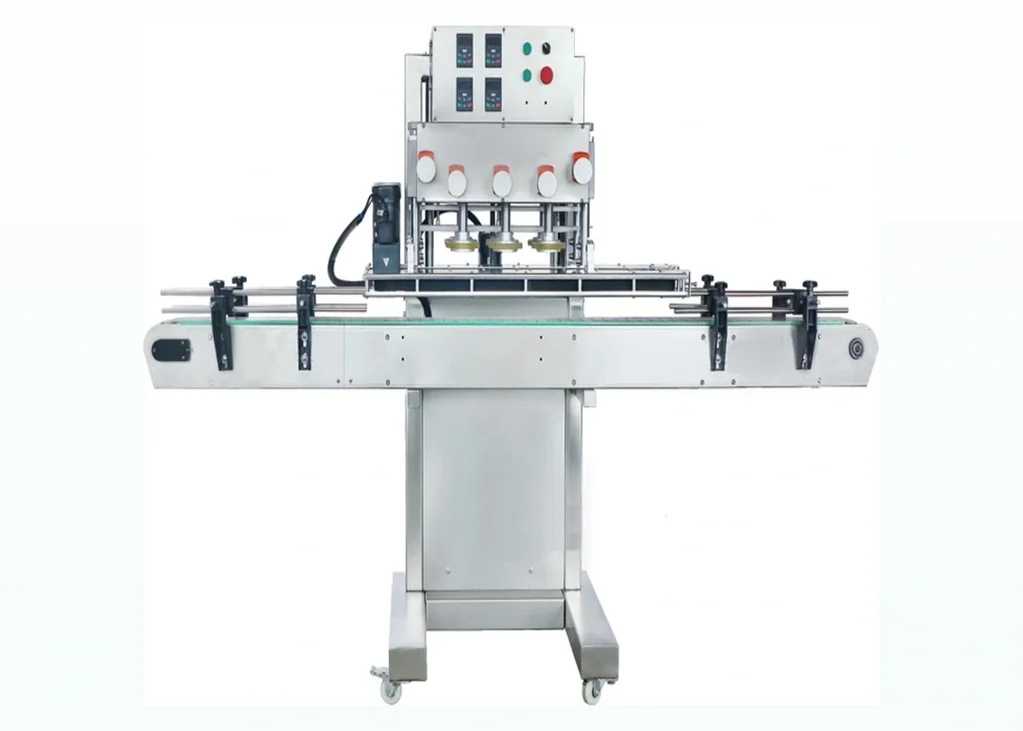
LU-XG440B-class automatic capper

LU-XG440B-class automatic belt and spindle capping machine.

An automatic inline screw-capping route with guiding belts, spindle tightening, PLC/touchscreen controls and cap-feeding options for compatible round-bottle production lines.

Automatic inline screw capping

Treat the published capacity as a screening range, not a guaranteed line result.

The LU-XG440B-class configuration uses guided bottle control and continuous spindle tightening for compatible screw caps. Sustained output depends on cap orientation, feeder recovery, bottle stability, product residue, conveyor flow, stop-and-restart behaviour and the agreed finished-pack inspection method.

Information Lancing needs

  • Production bottle and closure samples
  • Drawings and material details where available
  • Required sustained output and batch pattern
  • Finished-pack quality and test method
  • Utilities, footprint and connected-line layout
Send the project evidence →

Specification boundary

Published ranges are not acceptance guarantees. Packaging variation, cap placement, product residue, operator method and line conditions can change the final configuration and sustained result.

Plan a controlled acceptance test →
Verified screening data

Published LU model-class specification.

The following values are taken from Lancing's current first-party specialist page. Approximate and format-dependent values remain explicitly qualified.

Model referenceLU-XG440B class
Published capacity3,000–5,000 bottles/hour, material and format dependent
Bottle diameter35–120 mm
Bottle height60–200 mm
Electrical supply110/220 V, 50–60 Hz
PowerApproximately 2 kW
Capper dimensionsApproximately 2000 × 900 × 1600 mm
With cap elevatorApproximately 3453 × 1393 × 2243 mm
ControlsPLC and touchscreen
Cap feedingCap elevator or vibratory bowl as ordered
IntegrationUpstream fillers and downstream inspection or labelling
Process and limitations

What controls the production result on a belt and spindle capper.

Bottle guidance

Side belts and guides must stabilise the bottle without distorting it. Round geometry alone does not prove that a lightweight or top-heavy pack will run correctly.

Cap presentation

The cap must arrive in the correct orientation and remain located on the neck before the spindle wheels apply tightening force.

Connected-line controls

Define the response to missing caps, cap starvation, blocked outfeed, upstream stops and downstream inspection so faults do not release uncontrolled packs.

Sample trial

Acceptance evidence for the automatic capping route.

  • Production bottles and caps from representative supply batches
  • Defined cap-feed method, refill method and feeder operating window
  • Target accepted output under a stated timed-run condition
  • Cap height, thread engagement, torque or opening and leak checks
  • Stop/start, blocked-outfeed, missing-cap and reject behaviour
  • Format parts, stored settings and first-off checks for every required changeover

Confirm the final machine around your pack.

Send the actual bottle, closure, target output and acceptance checks. Lancing can review whether this model class is suitable or whether a different capping route is more practical.

Request machine advice
Call nowContact us