
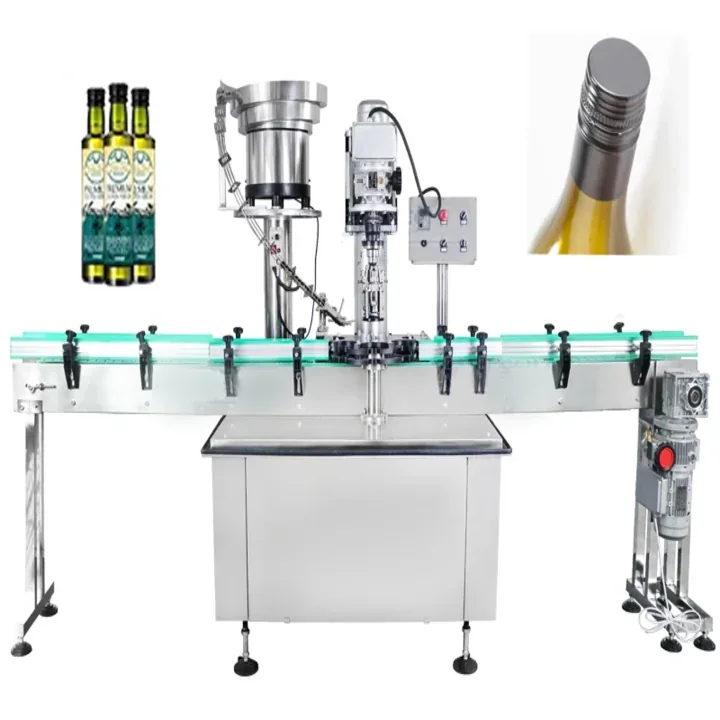
Rotary capping machines for higher-output bottle lines.
Rotary capping machine advice for higher-output bottle lines. UK support for cap type, starwheels, bottle handling, torque and line integration.
Discuss this requirement →Rotary capping machines are considered when output, timing and continuous production demands exceed a simpler inline route. The bottle is normally controlled through starwheels or indexing systems while one or more heads close the cap.
Rotary capping machines are considered when output, timing and continuous production demands exceed a simpler inline route. The bottle is normally controlled through starwheels or indexing systems while one or more heads close the cap.

Rotary capping machine advice for higher-output bottle lines. UK support for cap type, starwheels, bottle handling, torque and line integration.
Discuss this requirement →Rotary machines can deliver strong throughput, but they usually need more change parts and more precise bottle control than compact inline cappers.
The cap feeder, chute, pick-up point and reject handling must support the required speed. A high-speed capper is only as reliable as its feed route.
Rotary capping often forms part of a larger filling, capping and labelling line. Conveyor height, accumulation and upstream timing should be reviewed early.
Photos and dimensions can start the discussion. Physical bottle and cap samples are normally the best way to confirm tooling, cap feeding, bottle support and realistic output.
Rotary capping may be preferred for higher speeds, stable repeated formats and lines where starwheel control is suitable.
They can be designed for changeover, but the number of change parts and settings is normally higher than a simple inline system.
Yes, ROPP heads can be used in rotary systems where the bottle and output requirement justify that approach.