
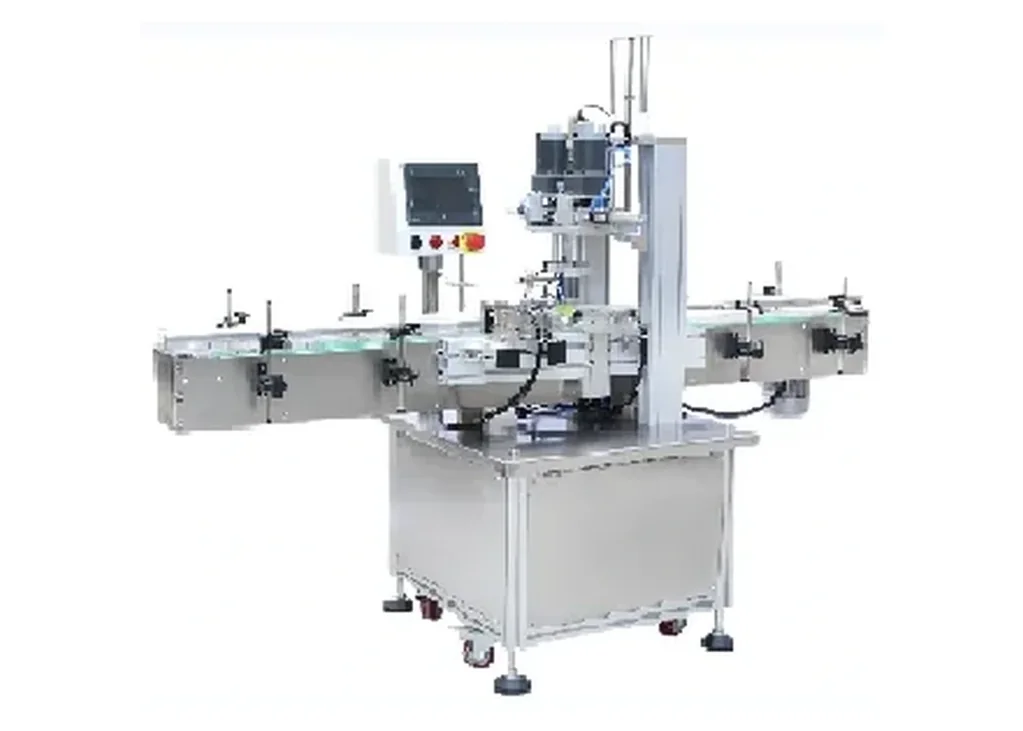
LU-XG1870 class
Compact inline screw capping machine
Use the published data to screen the project, then confirm suitability, tooling and acceptance with production-equivalent samples.
Open the Lancing specialist compact screw capper page →A space-conscious conveyor-based screw capping route for compatible standard caps, spray closures and pump collars where guided transfer and practical changeovers are required.
The LU-XG1870-class route is intended for compact production areas where a short conveyor and adjustable capping arrangement can support compatible threaded closures. Cap geometry, actuator clearance, bottle stability and conveyor handover must be checked using real samples before the final machine scope is fixed.
Use the published data to screen the project, then confirm suitability, tooling and acceptance with production-equivalent samples.
Open the Lancing specialist compact screw capper page →Published ranges are not acceptance guarantees. Packaging variation, cap placement, product residue, operator method and line conditions can change the final configuration and sustained result.
Plan a controlled acceptance test →The following values are taken from Lancing's current first-party specialist page. Approximate and format-dependent values remain explicitly qualified.
| Model reference | LU-XG1870 class |
|---|---|
| Cap diameter | 18–70 mm |
| Bottle height | Approximately 60–270 mm |
| Published working speed | Approximately 20–40 bottles/min, format dependent |
| Working pressure | 0.4–0.6 MPa |
| Electrical supply | AC 220/110 V, 50–60 Hz |
| Machine dimensions | Approximately 1120 × 580 × 1110 mm |
| Conveyor length | Approximately 1117 mm |
| Published application | Compatible sprays, pumps and standard screw caps |
| Integration | Bench-top or inline with a short conveyor, subject to layout review |
Confirm that the bottle enters, locates and leaves without tipping, rotating or colliding with guides at normal filled weight.
Pump and spray closures require clearance around the actuator, collar and dip tube. The capping contact must not trigger or damage the dispenser.
Where the machine connects to filling or labelling equipment, agree conveyor height, bottle spacing, accumulation and blocked-outfeed response.
Send the actual bottle, closure, target output and acceptance checks. Lancing can review whether this model class is suitable or whether a different capping route is more practical.
Request machine advice